
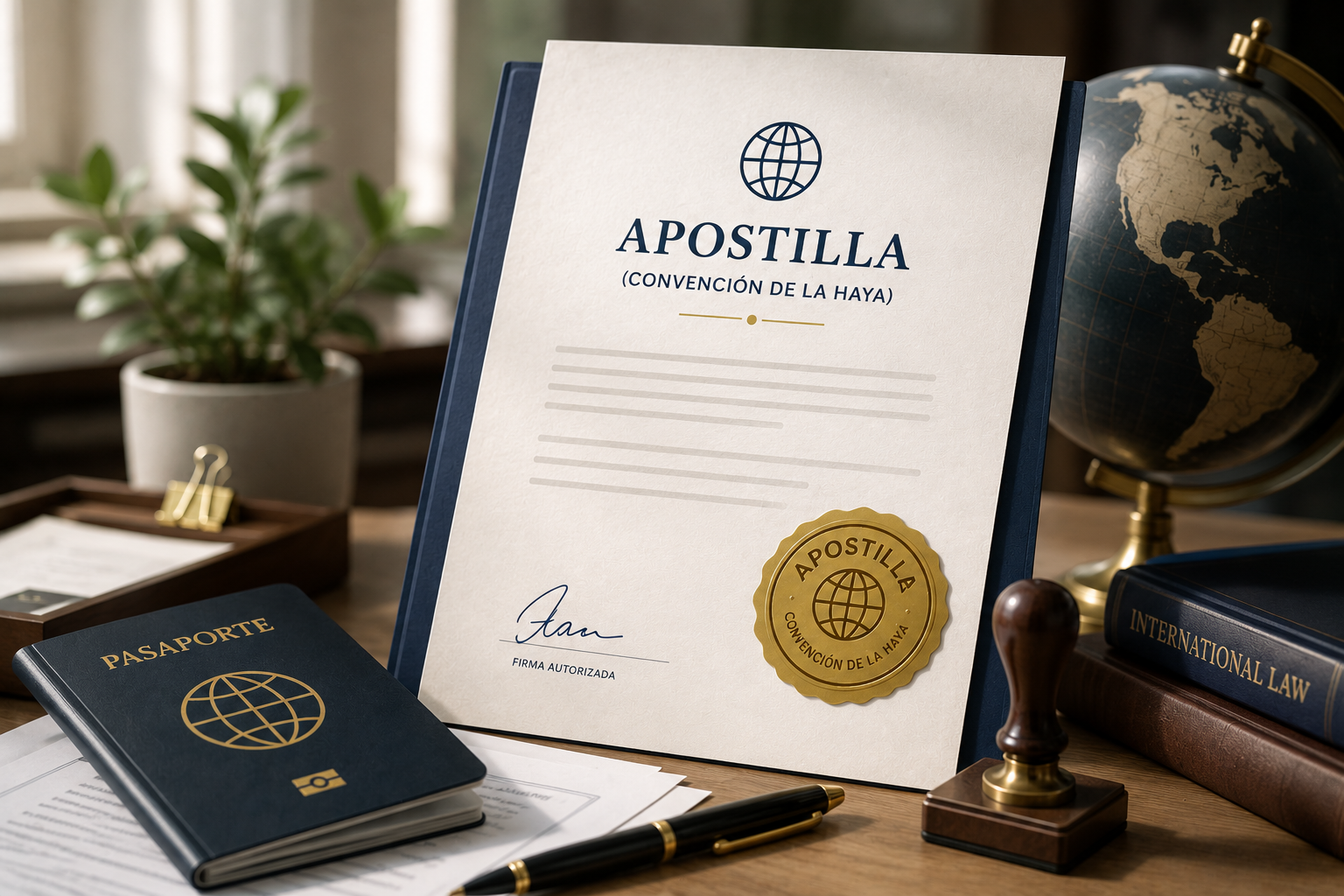
The Hague Apostille is a key element in any international procedure involving official documents. Thanks to this system, a public document issued in one country can be accepted by a foreign authority without having to go through complex diplomatic legalization procedures.
Both individuals and companies often find themselves needing to have documents apostilled in order to study, work, live, or carry out professional activities in Spain or abroad. However, it is common for significant questions to arise, especially regarding the difference between an apostille, legalization, and a certified translation, as well as the correct order in which these procedures should be carried out. Understanding what an apostille is, what it actually certifies, and how it is used not only prevents mistakes but also allows you to prepare the documentation correctly from the start and reduce unnecessary time and costs.
What is the Hague Apostille?
The Hague Apostille is an official certification governed by the Hague Convention of October 5, 1961. Its purpose is to simplify the international recognition of public documents among the countries that are parties to this convention.
In practical terms, an apostille certifies that a document is authentic in form—that is, that the signature it contains is valid, that the person who signed it has the authority to do so, and that the seal, if any, is official. It does not evaluate the content of the document, which often leads to confusion.
Before this system was created, documents required for procedures abroad had to undergo multiple legalization steps with various national authorities and consulates. The apostille simplifies this process by providing a single certification recognized by all States party to the convention, so that documents can be accepted in other countries without the need for additional legalizations.
What does an apostille actually certify?
The Hague Apostille certifies the formal authenticity of a document, but does not validate its content. Specifically, it certifies the authenticity of the signature appearing on the document, the identity and position of the person who signed it, and, if present, the authenticity of the official seal.
In other words, the apostille certifies that the document has been issued or validated by a competent authority, but it does not guarantee the accuracy of the information it contains.
This point is important because it explains why the apostille does not replace other documentary requirements or eliminate the need to provide certified translations when required.
When is an apostille required?
A document must be apostilled when it is to be submitted outside the country where it was issued and the receiving authority needs to verify its authenticity.
In practice, the apostille is commonly used in numerous international procedures related to the movement of people, education, business activities, or administrative formalities with foreign agencies.
In what cases is it necessary for individuals to have documents apostilled? Citizens often need documents with an apostille when carrying out procedures in another country related to education, work, residency, or marital status.
An apostille is often required for citizenship applications, immigration proceedings, visa or residence permit applications, international marriages, registrations in foreign civil registries, inheritances with international elements, or the recognition and validation of academic degrees.
It is also often required when a person wishes to enroll in a foreign university, have their studies in another country recognized, or submit official documentation to a foreign government agency.
In what cases is it necessary to have documents apostilled for businesses? Companies also frequently use the apostille when conducting business outside of Spain or maintaining legal relationships with foreign entities.
Opening branches, incorporating companies in other countries, appointing legal representatives, formalizing international commercial transactions, or participating in administrative and judicial proceedings abroad are some of the situations in which corporate documents may require an apostille.
In these cases, certification allows for the verification of the authenticity of corporate, notarial, or registry documents before foreign authorities.
Which documents can be apostilled?
Public documents issued by official agencies, or private documents that have become public through notarization, may be apostilled.
This includes certificates issued by the Civil Registry, academic records, notarized documents, court rulings, and various certificates issued by public agencies. Whether a document can be apostilled will always depend on whether the signature on it can be verified by the competent authority responsible for issuing the apostille.
Who issues the Hague Apostille in Spain?
In Spain, the authority to issue apostilles depends on the type of document. In practice, jurisdiction depends on who issued the original document.
The Ministry of Justice is generally responsible for overseeing the judicial bodies and notary associations, which are in charge of verifying the authenticity of signatures and issuing the corresponding certification.
This division of responsibilities is important because not all documents are apostilled by the same agency, and going to the right place from the start prevents unnecessary trips and delays.
What is the difference between an electronic apostille and a paper apostille?
The digital transformation of public administrations has enabled the implementation of electronic apostille systems in numerous procedures.
The so-called e-Apostille has the same legal validity as the traditional paper apostille and allows the authenticity of the certification to be verified digitally through secure validation systems.
However, before using electronically apostilled documents, it is advisable to verify that the receiving authority accepts this format, especially when dealing with foreign agencies, since not all of them apply the same criteria in practice.
Difference Between an Apostille and Diplomatic Legalization
Although they are often used interchangeably and serve the same purpose, an apostille and legalization are not equivalent concepts.
Legalization is the general procedure by which a document becomes valid for use in another country. The Hague Apostille is a simplified form of legalization that can only be used among countries that are parties to the Hague Convention.
When the destination country is not a party to this agreement, it will usually be necessary to follow a diplomatic or consular legalization procedure, which typically involves the participation of various national and foreign authorities.
For this reason, before beginning any international procedure, it is advisable to check which system is required by the country where the documentation will be submitted.
Can a certified translation be apostilled?
An apostille and a certified translation are two different procedures, but they are very often required together. This is one of the points that raises the most questions, and it’s important to clarify that certified translations are not apostilled. The apostille may only be applied to original documents issued by a competent authority. A certified translation is a separate document prepared by a certified translator appointed by the MAEC (Ministry of Foreign Affairs, European Union, and Cooperation), whose role is to certify the accuracy and fidelity of a translation.
Therefore, when a government agency requests an apostilled and translated document, it is not requiring an "apostilled translation." What you need is an original document that has been properly apostilled, accompanied by its corresponding certified translation.
Does the apostille need to be translated as well?
In many cases, yes.
Although the Hague Apostille follows a standardized international format, many government agencies, universities, and public institutions require that all submitted documents be translated into the official language of the proceedings.
For this reason, when a certified translation is performed, both the original document and the apostille attached to it are usually translated.
This is a detail that should be verified in advance, since the specific requirements will always depend on the authority to which the documentation is to be submitted.
The Correct Order for Apostilling and Translating a Document
Following the proper procedure is essential to prevent incidents.
The standard procedure involves first obtaining the original document, having it apostilled or legalized when necessary, and then having the entire document translated by a certified translator.
Translating a document before obtaining an apostille is one of the most common mistakes and often requires the translation to be redone to include the certification issued afterward.
Common Mistakes When Apostilling Documents
Many administrative delays stem from easily avoidable mistakes.
Among the most common mistakes are submitting expired documents, failing to check whether the destination country is a party to the Hague Convention, confusing the apostille with a certified translation, or assuming that the two serve the same purpose.
It is also common to request a translation before obtaining the apostille or to be unaware that certain authorities also require the certification itself to be translated.
A preliminary review of the requirements applicable to the specific procedure usually helps avoid problems, additional costs, and unnecessary delays.
Frequently Asked Questions About the Hague Apostille
Does the apostille have an expiration date?
An apostille does not expire on its own. However, the document it accompanies may become invalid over time if the receiving authority requires that it have been issued recently.
Is an apostille the same as a certified translation?
No. An apostille certifies the formal authenticity of a public document, while a certified translation attests that its content has been faithfully translated into another language. These are distinct yet complementary procedures.
Can a certified translation be apostilled?
No. An apostille may only be affixed to the original document issued by a competent authority.
Does the apostille need to be translated?
It depends on the requirements of the receiving authority. In many international procedures, the certified translation must include both the original document and the apostille itself.
What happens if the destination country is not a party to the Hague Convention?
In that case, it will usually be necessary to follow a diplomatic or consular legalization procedure rather than obtain an apostille.
Can all documents be apostilled?
No. The apostille may only be applied to public documents or to certain private documents that have acquired public status through notarial certification.
Which comes first, getting an apostille or having the document translated?
The correct procedure is to obtain the original document, have it apostilled when necessary, and then have the entire document translated by a certified translator.
Is the apostille valid in any country?
No. The Hague Apostille is valid only among the states that are parties to the Hague Convention. When the destination country is not a party to the convention, it is usually necessary to obtain diplomatic or consular legalization.
Why is it important to fully understand the apostille before beginning an international procedure? The Hague Apostille has become an essential tool for facilitating the international recognition of public documents. Its use simplifies administrative procedures, reduces red tape, and ensures that documents issued in one country can be officially accepted in another with greater legal certainty.
Understanding the differences between an apostille, legalization, and a certified translation—as well as knowing when each procedure is necessary—is essential for properly preparing documentation and avoiding issues in academic, business, immigration, or administrative processes conducted internationally.






.svg)
.svg)


.svg)
